Equipment › Artec Neo
Wireless · Tolerance-driven · Featured scanner
Artec Neo
Accuracy where it matters, not everywhere.
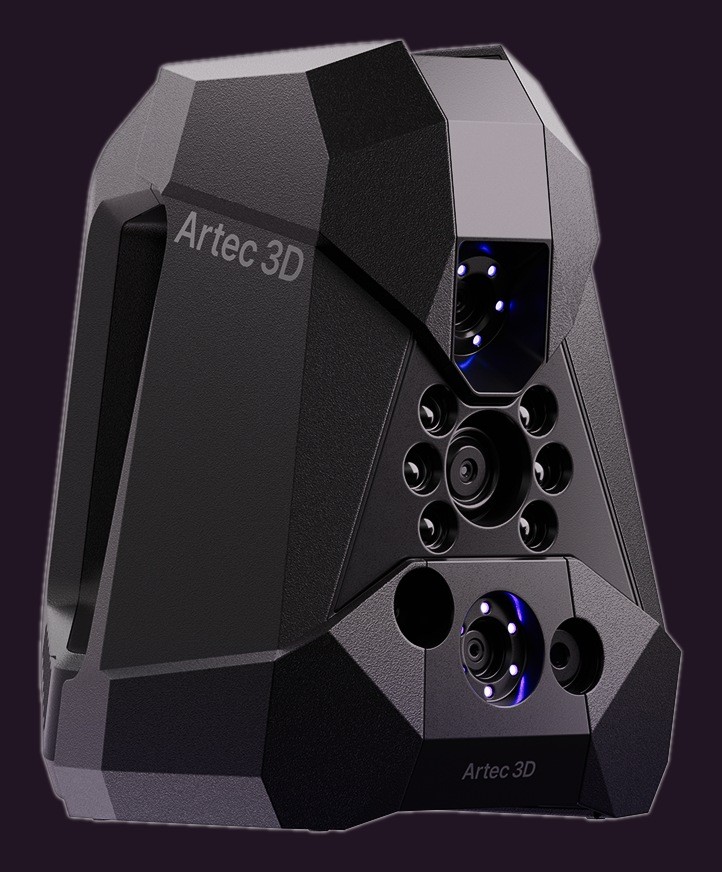
Chasing high accuracy across a whole part is expensive and mostly wasted. Most parts have three or four features that have to fit, and a lot of surface that simply has to be the right shape. Neo lets you treat those differently — place targets on the features that carry a tolerance, scan the rest target-free, and get one model back. No cable, no laptop balanced on a crate.
1-289-300-SCAN (7226) · [email protected]
Why we love this scanner
The number nobody explains
01
Point accuracy is not what ruins a big scan. Drift is.
Every handheld scanner is quoted twice: a point accuracy, and an error that accumulates as you track across the object. The second number is the one that decides whether a large part comes out usable, and it is the one almost nobody talks about.
Read those three lines again, because the interesting one is the gap between the second and the third — and it is the same scanner in both.
Targets are a dial, not a switch
Target-free, Neo drifts like any other handheld scanner: 0.3 mm for every metre you track. That is honest, and it is what the physics gives you. On a part the size of a bread box it does not matter at all.
Put targets down and that term falls to 0.035 mm/m. Over a metre of tracking that is the difference between 0.3 mm of accumulated error and 0.035 mm — and you did not buy a different machine to get it.
Here is the part that matters commercially: you do not have to target the whole part. Targets go where the tolerance is. The three bores that have to fit get them; the cast surface around them does not. You get the tight number exactly where the drawing asks for it, and the fast target-free sweep everywhere else, in one pass and one model.
That is what we mean by tolerance-driven: you decide where the accuracy has to be, and you only pay for it there. Targets are not unique to Neo — plenty of scanners support them. What is unusual is getting them alongside Spider-class optics with no cable attached.
02
Tolerance-driven, in practice
You are not choosing between fast and accurate for the whole job any more. A housing with three bores that have to fit and a lot of cast surface around them gets targets on the bores and a target-free sweep everywhere else. One pass, one model, and the accuracy is spent where the drawing actually cares.
It is the same argument we make about scanning generally: decide what the measurement is for, then buy exactly as much accuracy as that decision needs.
03
Wireless, and it stays wireless
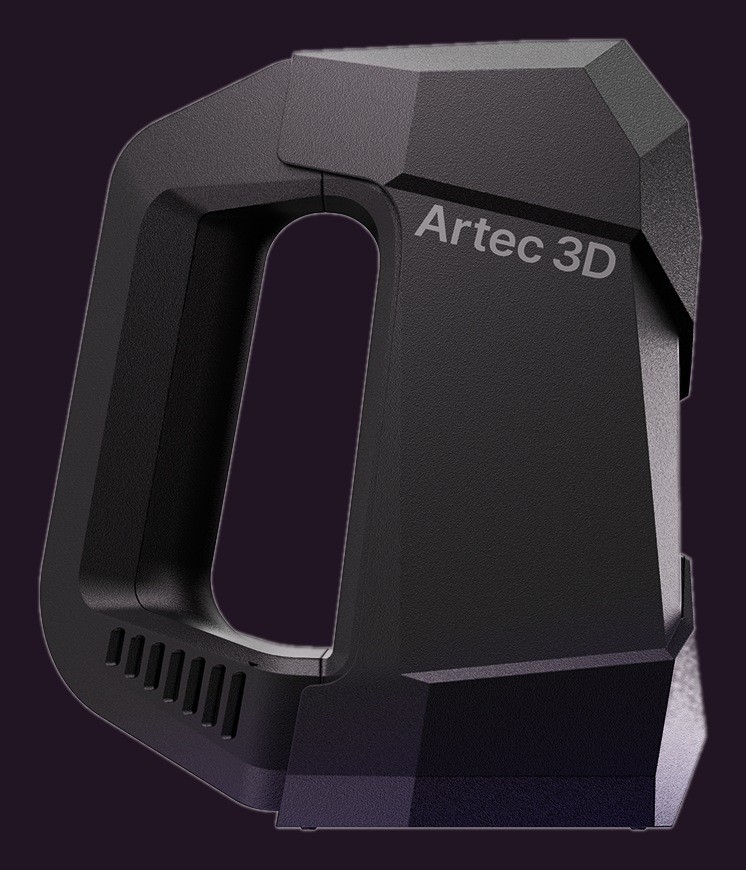
Blue LED structured light, no tether, four batteries in the box at 40–50 minutes each. That is the difference between a scanner you take to the part and a scanner the part has to be brought to. If you have ever run an extension lead across a shop floor to reach a machine that cannot be moved, you already know what this is worth.
There is a Thunderbolt 3 connection as well when you want it.
04
It is not the answer to everything
Neo is built for small to medium objects — working distance 0.19 to 0.3 m, field of view from 128 × 104 mm to 171 × 152 mm. It is not the tool for a vehicle or a building, and unlike Artec Leo it has no onboard computer, so it needs a Windows machine with an NVIDIA RTX card to run Artec Studio.
For medium-to-large objects captured on site, that is Leo. For the largest work, Ray II or Jet. We will tell you which one fits before you spend anything.
Better together
Most jobs are not one scanner
Cover the ground with a wide-field scanner, resolve the critical areas with a fine-detail one, and merge both in Artec Studio along with photographs, video and CAD data. Every scanner has a strong point — use each one for its strong point.
Published specifications
The numbers
Manufacturer figures, reproduced as published. Real-world results depend on surface, lighting and geometry.
Specifications as published by the manufacturer for the Artec Neo 3D scanner. ScanScanScan3D is a Gold Certified Artec 3D Partner and an authorized Canadian reseller.
Specifications never give the full picture of what a scanner can and cannot do. Seeing the results with YOUR project under your conditions is what counts. Talk to experts like us.
Get a Canadian price (or USD) on the Neo
Tell us about the parts you need to measure and where the tolerances actually are. We will tell you whether this is the right choice — including honest answers if it is not.